|
Aleph-w
1.5a.2
Biblioteca general de algoritmos y estructuras de datos
|


|
|
Aleph-w
1.5a.2
Biblioteca general de algoritmos y estructuras de datos
|
|
#include <tpl_dynMapTree.H>
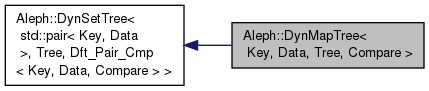
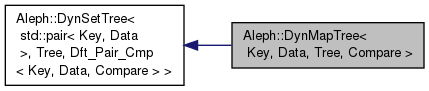
 Diagrama de herencias de Aleph::DynMapTree< Key, Data, Tree, Compare > Diagrama de colaboración para Aleph::DynMapTree< Key, Data, Tree, Compare >:
Tipos públicos | |
| typedef Key | Key_Type |
| typedef Key | Item_Type |
| typedef Data | Value_Type |
| Tipos públicos heredados desde Aleph::DynSetTree< std::pair< Key, Data >, Tree, Dft_Pair_Cmp< Key, Data, Compare > > | |
| typedef Tree< std::pair< Key, Data >, Dft_Pair_Cmp< Key, Data, Compare > >::Node | Node |
| typedef DynSetTree | Set_Type |
| typedef std::pair< Key, Data > | Item_Type |
| typedef std::pair< Key, Data > | Key_Type |
Métodos públicos | |
| Data & | get_data (const Key &key) |
| const Key & | get_key (Data *data_ptr) |
| Key * | insert (const Key &key, const Data &data) |
| Key * | insert (const Key &key, Data &&data=Data()) |
| Key * | insert (Key &&key, const Data &data) |
| Key * | insert (Key &&key, Data &&data=Data()) |
| Key * | search_or_insert (const Key &key, const Data &data) |
| Data * | search_or_insert (const Key &key, Data &&data) |
| Data * | search_or_insert (Key &&key, const Data &data) |
| Data * | search_or_insert (Key &&key, Data &&data) |
| Key * | put (const Key &key, const Data &data) |
| Key * | put (const Key &key, Data &&data) |
| Key * | put (Key &&key, const Data &data) |
| Key * | put (Key &&key, Data &&data) |
| size_t | remove (const Key &key) |
| bool | test_key (const Key &key) const |
| Retorna true si key está presente dentro del mapeo. | |
| bool | has (const Key &key) const |
| Data * | test (const Key &key) |
| Data * | search (const Key &key) const |
| Data & | find (const Key &key) |
| Map_Sequences_Methods () | |
| Generate_Proxy_Operator (DynMapTree) | |
| Métodos públicos heredados desde Aleph::DynSetTree< std::pair< Key, Data >, Tree, Dft_Pair_Cmp< Key, Data, Compare > > | |
| void | swap (DynSetTree &dset) |
| DynSetTree (Dft_Pair_Cmp< Key, Data, Compare > &&cmp=Dft_Pair_Cmp< Key, Data, Compare >()) | |
| Instancia un conjunto dinámico vacío. | |
| DynSetTree (Dft_Pair_Cmp< Key, Data, Compare > &cmp) | |
| DynSetTree (const DynSetTree &srcTree) | |
| Instancia un conjunto dinámico copia de srcTree. | |
| DynSetTree (const DynList< std::pair< Key, Data > > &list) | |
| DynSetTree (DynSetTree &&srcTree) | |
| void | empty () |
| Elimina todos los elementos del conjunto. | |
| DynSetTree & | operator= (const DynList< std::pair< Key, Data > > &list) |
| DynSetTree & | operator= (const DynSetTree &srcTree) |
| Asigna a this el conjunto dinámico srcTree. | |
| DynSetTree & | operator= (DynSetTree &&srcTree) |
| Asigna a this el conjunto dinámico srcTree. | |
| virtual | ~DynSetTree () |
| Destructor; todos los elementos son liberados. | |
| std::pair< Key, Data > * | insert (const std::pair< Key, Data > &key) |
| std::pair< Key, Data > * | insert (std::pair< Key, Data > &&key) |
| std::pair< Key, Data > * | append (const std::pair< Key, Data > &key) |
| std::pair< Key, Data > * | append (std::pair< Key, Data > &&key) |
| std::pair< Key, Data > * | search_or_insert (const std::pair< Key, Data > &key) |
| std::pair< Key, Data > * | search_or_insert (std::pair< Key, Data > &&key) |
| std::pair< Key, Data > * | insert_dup (const std::pair< Key, Data > &key) |
| std::pair< Key, Data > * | insert_dup (std::pair< Key, Data > &&key) |
| std::pair< Key, Data > * | put (const std::pair< Key, Data > &key) |
| Seudo sinonimo de insert; no retorna ningún valor. | |
| std::pair< Key, Data > * | put (std::pair< Key, Data > &&key) |
| size_t | remove (const std::pair< Key, Data > &key) |
| bool | exist (const std::pair< Key, Data > &key) const |
| Retorna true si key pertenece al conjunto dinámico. | |
| bool | has (const std::pair< Key, Data > &key) const |
| bool | contains (const std::pair< Key, Data > &key) const |
| std::pair< Key, Data > & | find (const std::pair< Key, Data > &key) throw (std::exception, std::domain_error) |
| std::pair< int, std::pair< Key, Data > * > | find_position (const std::pair< Key, Data > &key) const |
| std::pair< Key, Data > * | search (const std::pair< Key, Data > &key) const throw (std::exception, std::domain_error) |
| const std::pair< Key, Data > & | min () const |
| const std::pair< Key, Data > & | get_first () |
| const std::pair< Key, Data > & | max () const |
| const std::pair< Key, Data > & | get_last () |
| const std::pair< Key, Data > & | get () |
| Sinónimo de max. | |
| const size_t & | size () const |
| Retorna la cardinalidad del conjunto. | |
| bool | is_empty () const |
| Retorna true si el conjunto está vacío. | |
| size_t | internal_path_length () const |
| Node * | get_root_node () const |
| const std::pair< Key, Data > & | get_root () const |
| size_t | height () const |
| Calcula y retorna la altura del árbol binario de búsqueda. | |
| void | for_each_in_preorder (void(*visitFct)(Node *, int, int)) |
| long | position (const std::pair< Key, Data > &key) const |
| std::pair< Key, Data > & | select (const size_t &i) |
| const std::pair< Key, Data > & | select (const size_t &i) const |
| std::pair< Key, Data > & | operator() (const size_t &i) |
| std::pair< Key, Data > & | access (const size_t &i) |
| bool | verify () |
| void | for_each_preorder (Key_Op &key_op) |
| void | for_each_preorder (Key_Op &&key_op=Key_Op()) |
| void | for_each_inorder (Key_Op &key_op) |
| void | for_each_inorder (Key_Op &&key_op=Key_Op()) |
| void | for_each_postorder (Key_Op &key_op) |
| void | for_each_postorder (Key_Op &&key_op=Key_Op()) |
| DynSetTree & | join (DynSetTree &t, DynSetTree &dup) |
| DynSetTree & | join (DynSetTree &t, DynSetTree &&dup=DynSetTree()) |
| DynSetTree & | join_dup (DynSetTree &t) |
| bool | split_key (const std::pair< Key, Data > &key, DynSetTree &l, DynSetTree &r) |
| void | split_pos (const size_t pos, DynSetTree &l, DynSetTree &r) |
| void | split_key_dup (const std::pair< Key, Data > &key, DynSetTree &l, DynSetTree &r) |
| bool | traverse (Operation &op) |
| bool | traverse (Operation &&op=Operation()) |
| bool | traverse (Operation &op) const |
| bool | traverse (Operation &&op=Operation()) const |
| Functional_Methods (std::pair< Key, Data >) | |
| Generic_Keys (std::pair< Key, Data >) | |
| Equal_To_Method (DynSetTree) | |
Mapeo genérico instrumentado con árboles binarios de búsqueda.
DynMapTree define un mapeo entre un conjunto de claves, que no se pueden repetir, y un conjunto rango. El mapeo se implanta mediante alguna clase de árbol binario de búsqueda definido como parámetros tipo.
Los parámetros tipo de esta clase se definen del siguiente modo:
Los elementos del mapeo pueden accederse mediante el operador [] colocando como parámetro la clave de indización.
|
inline |
Retorna dato asociado a una clave.
search(key) retorna un puntero al valor del dato asociado a la clave key.
| [in] | key | clave a buscar. |
| domain_error | si la clave no está dentro del mapeo |
Referenciado por Aleph::Huffman_Encoder_Engine::encode().
Gráfico de llamadas a esta función:
|
inline |
Inserta un par en el mapeo.
insert(key,data) inserta en el mapeo un nuevo par (key,data) indizado por el valor de key. La operación no realiza inserción si el valor de key ya está presente en el mapeo.
| [in] | key | clave a insertar. |
| [in] | data | valor a indizar por la clave key. |
| bad_alloc | si no hay suficiente memoria. |
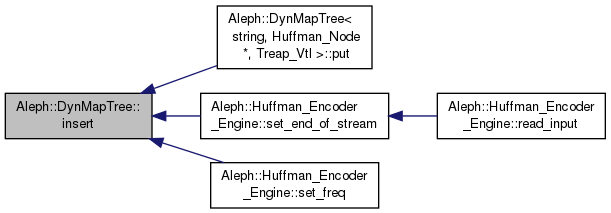
Referenciado por Aleph::DynMapTree< string, Huffman_Node *, Treap_Vtl >::put(), Aleph::Huffman_Encoder_Engine::set_end_of_stream() y Aleph::Huffman_Encoder_Engine::set_freq().
Gráfico de llamadas a esta función:
|
inline |
Inserta un par en el mapeo.
put(key,data) inserta en el mapeo un nuevo par (key,data) indizado por el valor de key. La operación no realiza inserción si el valor de key ya está presente en el mapeo.
| [in] | key | clave a insertar. |
| [in] | data | valor a indizar por la clave key. |
| bad_alloc | si no hay suficiente memoria. |
|
inline |
Elimina el dato asociado a la clave key.
remove(key) elimina del mapeo el dato asociado a la clave key.
| [in] | key | clave a eliminar. |
|
inline |
Retorna dato asociado a una clave.
search(key) retorna un puntero al valor del dato asociado a la clave key.
| [in] | key | clave a buscar. |
|
inline |
Busca la clave key en el árbol binario de búsqueda o lo inserta en caso de no encontrarse.
search_or_insert(key) busca en el árbol binario un nodo cuya clave sea KEY(p). Si la clave se encuentra, entonces se retorna un puntero a ella; de lo contrario se inserta key en el árbol binario de búsqueda this.
| [in] | key | la clave a buscar o insertar. |
|
inline |
Retorna dato asociado a una clave.
test(key) retorna un puntero al valor del dato asociado a la clave key.
| [in] | key | clave a buscar. |
Referenciado por Aleph::Huffman_Encoder_Engine::set_freq().
Gráfico de llamadas a esta función: